Chhattisgarh's Industrial Development Policy (IDP) 2024-30 is one of the most generous incentive frameworks any Indian state currently offers manufacturers and service businesses. Capital subsidies run as high as 45%, state GST can be reimbursed for up to a decade, and electricity duty is waived entirely for years. Yet the policy is dense, and most operators never claim what they are owed simply because the numbers are buried in tables and clauses.
This guide rewrites the policy into something you can act on. If you are a founder, an MSME owner, or a manufacturer evaluating where to set up or expand a unit, read it end to end. By the close you will know which incentives apply to your business, how much each is worth, and the exact steps to file a claim.
The policy runs from 1 November 2024 to 31 March 2030. The last major amendment was noted on 27 May 2025. Always confirm figures against the official documents linked at the end before committing capital.
Who Should Read This
The IDP 2024-30 is built around three beneficiary types, and the right incentives depend heavily on which one you are:
- MSMEs (micro, small, medium) in manufacturing or services chasing capital and tax relief.
- DPIIT-recognised startups seeking seed funding, rent, technology, and patent support.
- Large and thrust-sector industries negotiating special packages worth up to 150% of fixed capital investment.
Special categories, including SC/ST, women, ex-servicemen, Agniveers, third-gender, Divyang, and surrendered Naxalite entrepreneurs, layer an extra 10% on top of most incentives.
District Classification: Where You Build Matters
Every benefit scales with location. The state divides its development blocks into three groups, and the more backward the block, the richer the package, by design, to push balanced regional growth.
- Group 1 (Developed): Urban blocks of Raipur and the Bilha block of Bilaspur. Lowest incentives.
- Group 2 (Semi-developed): Other urban and semi-urban blocks. Mid-tier incentives.
- Group 3 (Backward / Aspirational): Rural and tribal blocks, including Naxal-affected areas. Highest incentives.
The practical takeaway: the same factory earns a meaningfully larger subsidy in a Group 3 block than in central Raipur. Factor this into your site selection before anything else.
Fixed Capital Investment Subsidy
This is the headline grant, a percentage of your fixed capital investment (FCI) paid back to you. Importantly, you choose either the FCI subsidy or net SGST reimbursement, not both, so model both before deciding.
The subsidy rate is fixed by district group regardless of enterprise size:
- Group 1: 35% of FCI
- Group 2: 40% of FCI
- Group 3: 45% of FCI
What changes with enterprise size is the maximum rupee cap. For manufacturing MSMEs, the ceilings climb sharply from micro to medium units:
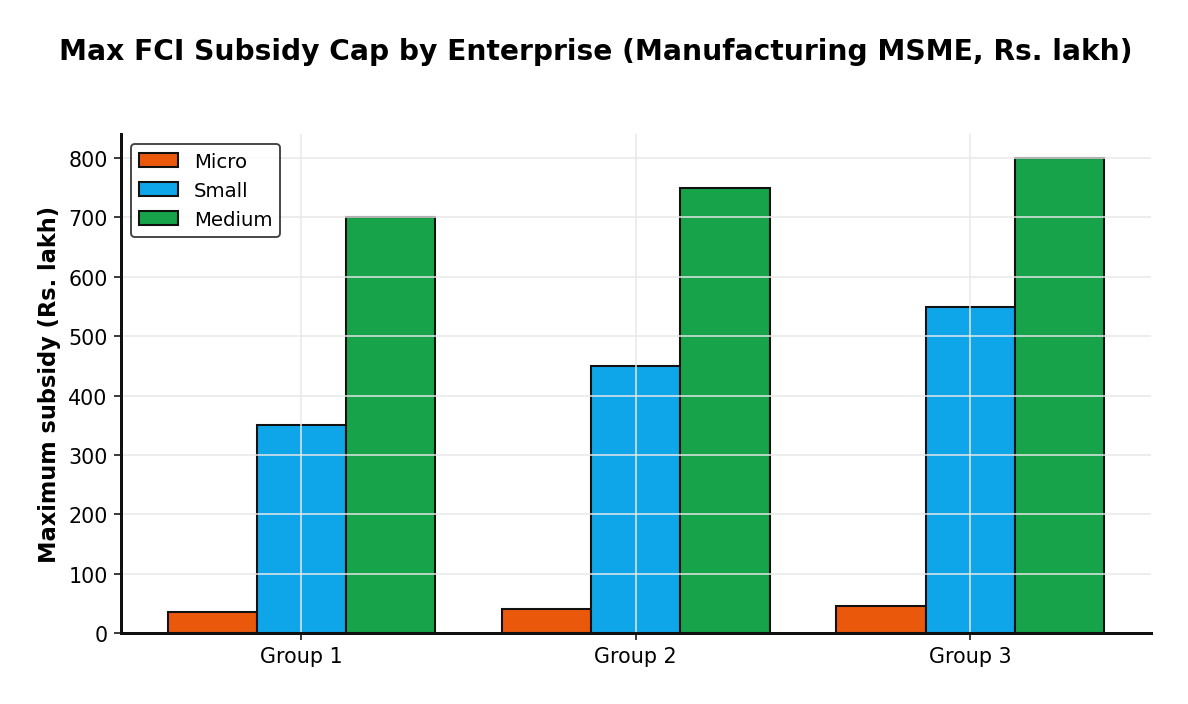
- Micro: up to Rs. 35 lakh (G1), Rs. 40 lakh (G2), Rs. 45 lakh (G3)
- Small: up to Rs. 3.50 cr (G1), Rs. 4.50 cr (G2), Rs. 5.50 cr (G3)
- Medium: up to Rs. 7 cr (G1), Rs. 7.50 cr (G2), Rs. 8 cr (G3)
Disbursement is staged after commercial production begins:
- Micro units receive a single installment.
- Small units receive three equal yearly installments.
- Medium units receive five equal yearly installments.
- The first installment lands only after two years of commercial production.
Two bonuses worth knowing: thrust-sector industries get an additional 5% on FCI plus 10% higher caps, and the first five anchor units investing over Rs. 200 crore earn an additional 5% FCI subsidy.
Net SGST Reimbursement: The Alternative Path
Instead of the upfront capital grant, you can have the state reimburse the SGST you pay on sales, an option that often suits high-turnover units. The reimbursement period and the cap (expressed as a percentage of your FCI) both grow with enterprise size and with backwardness of the district.
For MSME manufacturing, the reimbursement window stretches from six years up to a full decade:
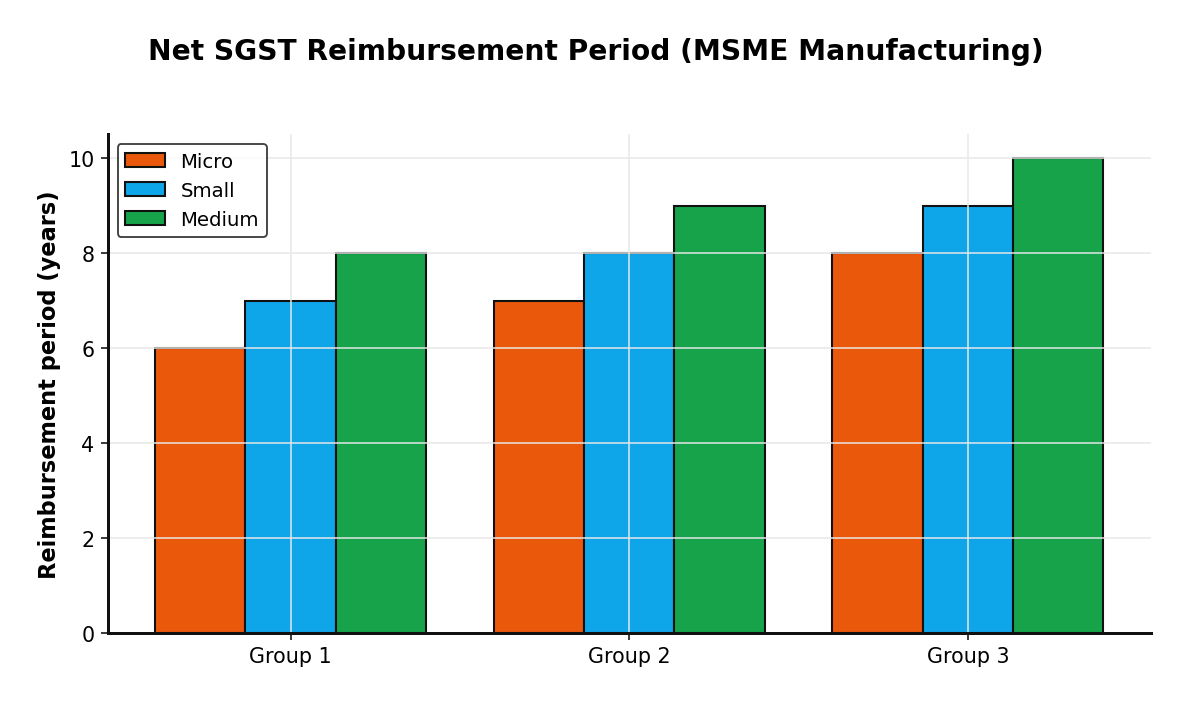
- Micro: 6 years up to 75% of FCI (G1) rising to 8 years up to 100% (G3)
- Small: 7 years up to 85% (G1) rising to 9 years up to 100% (G3)
- Medium: 8 years up to 100% (G1) rising to 10 years up to 110% (G3)
Large industries in special sectors do even better. Pharma, textile, and electronics units get 100% SGST reimbursement for 12 years, capped at up to 150% of fixed capital investment, effectively recovering more than they invested.
Interest Subsidy
On term loans from scheduled banks and financial institutions, the state subsidises your interest. The rate steps up by district group:
- Group 1: 45% for 6 years
- Group 2: 50% for 7 years
- Group 3: 55% for 8 years
The annual rupee cap rises with enterprise size, from Rs. 20 lakh per year for a Group 1 micro unit up to Rs. 50 lakh per year for a Group 3 medium unit. Large enterprises receive 40-60% interest subsidy for five to seven years depending on sector and location.
Tax and Duty Exemptions
Beyond cash subsidies, the policy strips out several recurring costs.
Stamp duty. A 100% exemption applies to the purchase of industrial land, the purchase or lease of buildings and sheds, lease agreements of at least five years, and loan documents for three years from sanction. Micro and small units also get a 50% exemption on land diversion fees, limited to 15 acres. Mining leases are excluded.
Electricity duty. New industries pay zero electricity duty, with the exemption period scaling by enterprise size and location, up to 12 years from the date of commercial production.
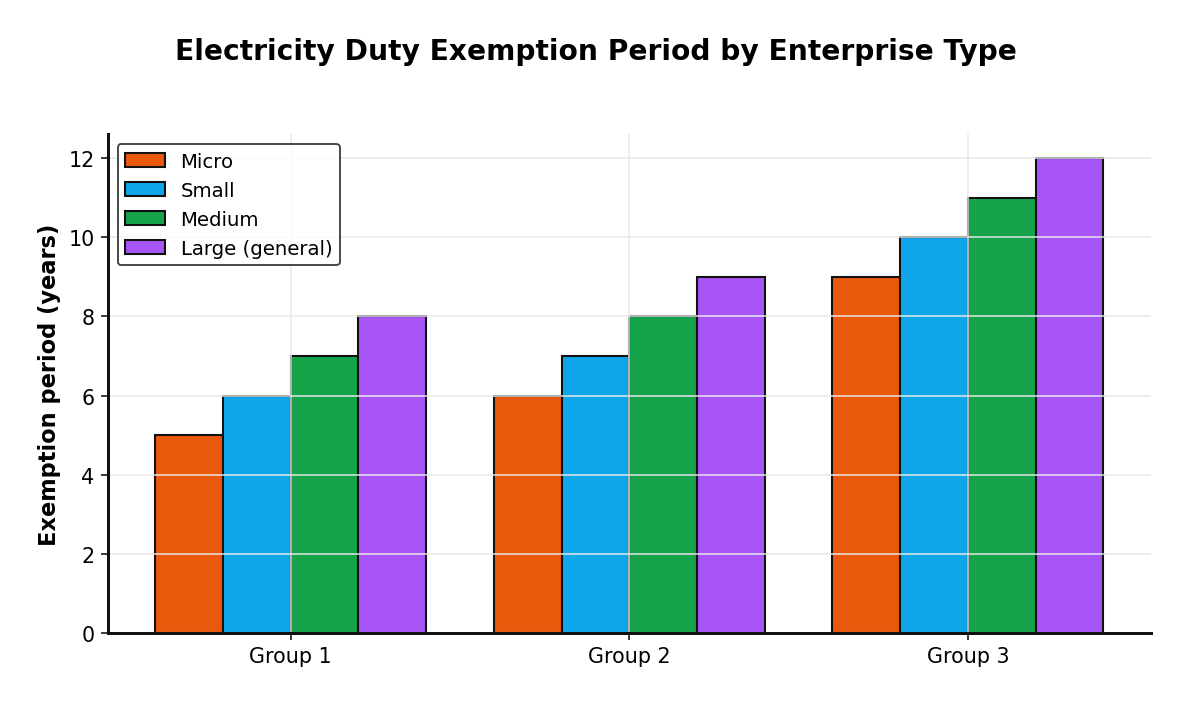
- Micro: 5 years (G1), 6 (G2), 9 (G3)
- Small: 6 years (G1), 7 (G2), 10 (G3)
- Medium: 7 years (G1), 8 (G2), 11 (G3)
- Large (general): 8 years (G1), 9 (G2), 12 (G3)
- Large (thrust): 10 years (G1), 11 (G2), 12 (G3)
Mandi tax. MSMEs in agriculture, food processing, and biofuel/ethanol get a 100% mandi tax exemption for five years, capped at Rs. 5 crore per year and an overall 75% of FCI.
The Startup Package
If you hold valid DPIIT recognition, are registered in Chhattisgarh, are no older than 10 years (5 for manufacturing), turn over under Rs. 100 crore, and work on genuine innovation, a separate and generous package opens up.
Staged seed funding can reach Rs. 11 lakh in total:
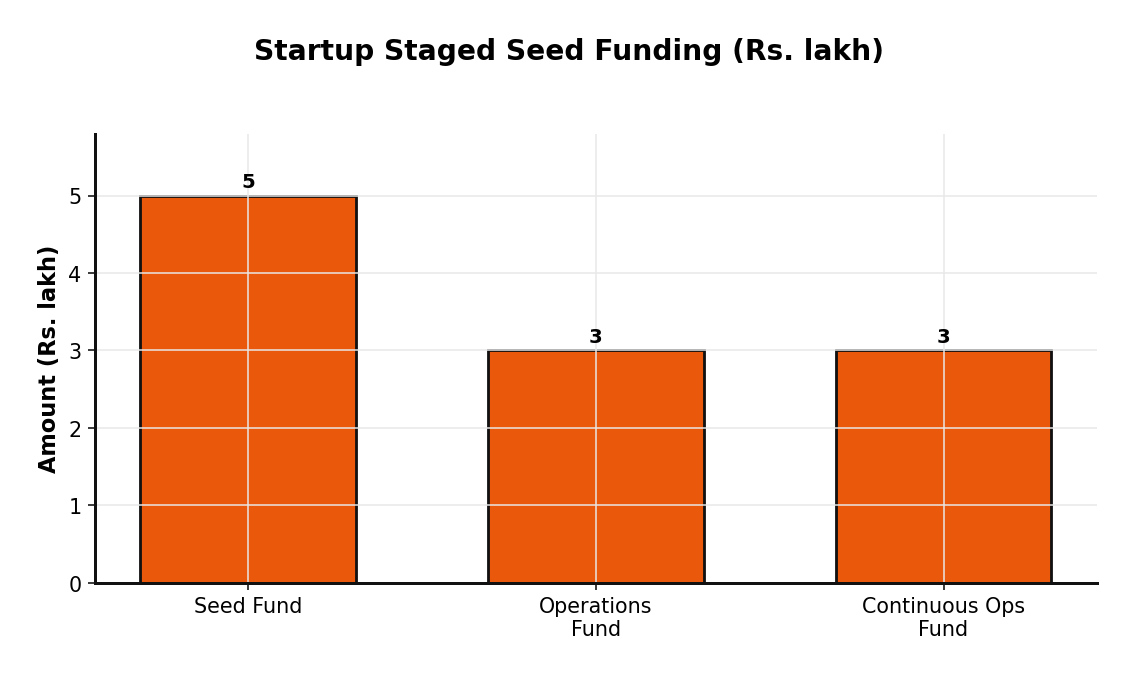
- Seed Fund: Rs. 5 lakh, on an incubation centre's recommendation.
- Operations Fund: Rs. 3 lakh, six months after commencing production or service.
- Continuous Operations Fund: Rs. 3 lakh, after one year of operations.
Layered on top:
- Rent subsidy: 40% of monthly rent, up to Rs. 15,000 per month, for 3 years, paid quarterly.
- Technology purchase: 50% of cost up to Rs. 10 lakh (from NRDC or approved sources).
- Patent filing: 50% of cost up to Rs. 10 lakh per patent (Rs. 20 lakh for multiple).
- Quality certification: 80% of cost up to Rs. 10 lakh (ISO 9000/14000/18000/22000, BIS and similar).
- Project report: 1% of approved FCI, up to Rs. 5 lakh for startups.
- Stamp duty: 100% exemption on land purchase or a five-year-plus lease.
- Credit Risk Fund: a Rs. 50 crore corpus, in partnership with SBI, provides collateral-free loans.
Special Categories and Thrust Sectors
Special-category entrepreneurs (SC/ST, women, ex-servicemen, Agniveers, third-gender, Divyang, surrendered Naxalites) receive an additional 10% subsidy and a 10% higher cap across industrial investment incentives. SC/ST young entrepreneurs get a 25% subsidy up to Rs. 1 crore for a first venture.
Thrust sectors earn enhanced incentives, an extra 5% FCI subsidy, 10% higher caps, longer SGST windows, and priority processing, provided they clear a minimum plant-and-machinery investment. Among the listed sectors: pharmaceuticals and medical devices, biotech and nanotech, white goods and electronics, IT/ITeS and AI/robotics, textiles, agro and food processing, defence and aerospace, renewable energy equipment, electric vehicles, green hydrogen, semiconductors, and herbal/minor-forest-produce. Thresholds range from Rs. 25 lakh (herbal) to Rs. 5 crore (semiconductors). Many of these thrust sectors line up directly with India's biggest import-substitution opportunities, where domestic demand already outstrips domestic supply.
Waste-based and circular-economy projects, such as a recycled-plastic or rice-husk pallet unit, qualify for thrust benefits too, plus a 50% machinery subsidy up to Rs. 25 lakh for pollution control and effluent treatment equipment.
How to Apply
The process runs through the state's single-window portal. Move in this order:
- Register on the Single Window Portal at oneclick.cgstate.gov.in using PAN-based login, and build your investor profile.
- Select the IDP 2024-30 option, choosing your enterprise category (micro/small/medium/large) and sector (general/thrust/special package).
- File the Common Application Form (CAF), listing all incentives, uploading documents, and paying fees via e-challan.
- Obtain your Enterprise Memorandum through Udyam/MSME registration.
- Apply for each specific incentive, which may require a separate application: FCI subsidy, interest subsidy, stamp duty, electricity duty, and SGST reimbursement.
- Track and follow up. Most clearances take 7-30 days, and a relationship manager is assigned for facilitation.
Startups additionally need DPIIT recognition at startupindia.gov.in, registration at industries.cg.gov.in/startupcg, and a recommendation from an approved incubator such as 36INC.
Keep these documents ready: PAN and Aadhaar, business registration, Udyam certificate, land and building documents, bank details, a detailed project report, GST registration, pollution-board consent, a CA-certified FCI statement, a term-loan sanction letter, and a Chhattisgarh domicile certificate for employment-linked benefits.
Key Dates and Timelines
- Policy window: 1 November 2024 to 31 March 2030.
- Portal registration: same day.
- Udyam registration: 1-2 days.
- DPIIT recognition: 2-7 days.
- Single-window clearances: 7-30 days.
- Land allotment (CSIDC): 30-60 days.
- First subsidy disbursement: after two years of commercial production.
- SGST reimbursement: claimed annually after GST filing.
The single biggest reason businesses underclaim is poor record-keeping. Subsidy, interest, and SGST claims all depend on clean, auditable trails of capital expenditure, GST filings, electricity bills, and employment records, often across several years.
Turning Policy Into Claimed Rupees
The IDP 2024-30 is worth lakhs to crores per unit, but only to businesses that track eligibility, file on time, and prove every expense. That is fundamentally a data problem. At DatCrazy we build custom dashboards and automation that help manufacturers and founders map their entitlements, monitor claim deadlines, and keep subsidy-grade compliance records ready for audit. If you would rather act on these incentives than wrestle with spreadsheets, that is exactly the kind of tooling we build.